
Geographical position and Climate of Nova Scotia
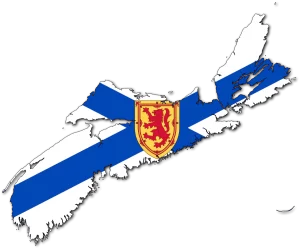
Nova Scotia is one of Canada’s three Maritime Provinces and is located on the country’s eastern coast. It is almost entirely surrounded by the Atlantic Ocean and is connected to the mainland by the narrow Isthmus of Chignecto. The province comprises the Nova Scotia peninsula, Cape Breton Island, and over 3,800 coastal islands.
The capital city of Halifax is situated centrally on the east coast of the peninsula, providing a strategic location for one of the largest natural harbors in the world. Nova Scotia’s coastline is characterized by numerous bays, coves, and estuaries, and its topography includes rolling hills, valleys, and rugged cliffs, particularly on Cape Breton Island.
Nova Scotia’s climate is classified as continental, moderated by the ocean, which results in milder winters and cooler summers compared to areas further inland at similar latitudes.
Best time to visit
The best time to visit Nova Scotia depends on the activities you’re interested in and the experiences you’re looking for:
- Summer (June to August): Warm temperatures and plenty of sunshine make summer the peak tourist season. It’s the perfect time for beach activities, hiking, festivals, and exploring the coastline.
- Fall (September to October): Known for its stunning fall foliage, this is a great time for scenic drives and outdoor activities in cooler, but still pleasant weather. Fall also has fewer tourists, making it ideal for those seeking a quieter visit.
- Winter (December to February): Winter sports enthusiasts will enjoy this season, as it offers opportunities for skiing, snowboarding, and ice skating. Coastal areas have milder winters compared to inland regions.
- Spring (March to May): Spring can be unpredictable with lingering cold and potential for late snowfalls, but it’s also the season when the province’s flora begins to bloom. May sees warmer temperatures and is a good time to avoid the summer crowds.
For whale watching, the best time is from late May to early September, while the lobster season varies by area but generally includes spring and fall.
Travel to Nova Scotia
Traveling to Nova Scotia is convenient with several options available:
- By Air: Halifax Stanfield International Airport (YHZ) is the main gateway, offering flights from various Canadian cities, as well as international destinations. The airport is located about 35 kilometers from downtown Halifax.
- By Car: If you’re coming from mainland Canada or the United States, you can drive to Nova Scotia via the Trans-Canada Highway (Highway 104 in Nova Scotia), which crosses the border into the province at Amherst.
- By Train: VIA Rail provides service to Nova Scotia from Montreal with the Ocean line, which terminates in Halifax.
- By Bus: Maritime Bus offers intercity bus service within the Maritime provinces, including multiple stops in Nova Scotia.
- By Ferry: There are several ferry services connecting Nova Scotia with neighboring regions:
- From New Brunswick: The Bay Ferries service operates between Saint John, NB, and Digby, NS.
- From Prince Edward Island: Northumberland Ferries runs between Wood Islands, PEI, and Caribou, NS.
- From Newfoundland: Marine Atlantic ferries connect North Sydney, NS, with Port aux Basques and Argentia, NL.
- From Maine, USA: The CAT high-speed ferry operates seasonally between Bar Harbor, Maine, and Yarmouth, NS.
When planning your trip, consider the most convenient point of entry based on your origin and the part of Nova Scotia you wish to visit. Keep in mind that some ferry services are seasonal and may not operate during the winter months.
Places to visit in Nova Scotia
Important Information
Capital – Halifax
Largest City – Halifax
Territory – 55,284 km2
Population – 1,079,440
Time Zone – UTC-4